
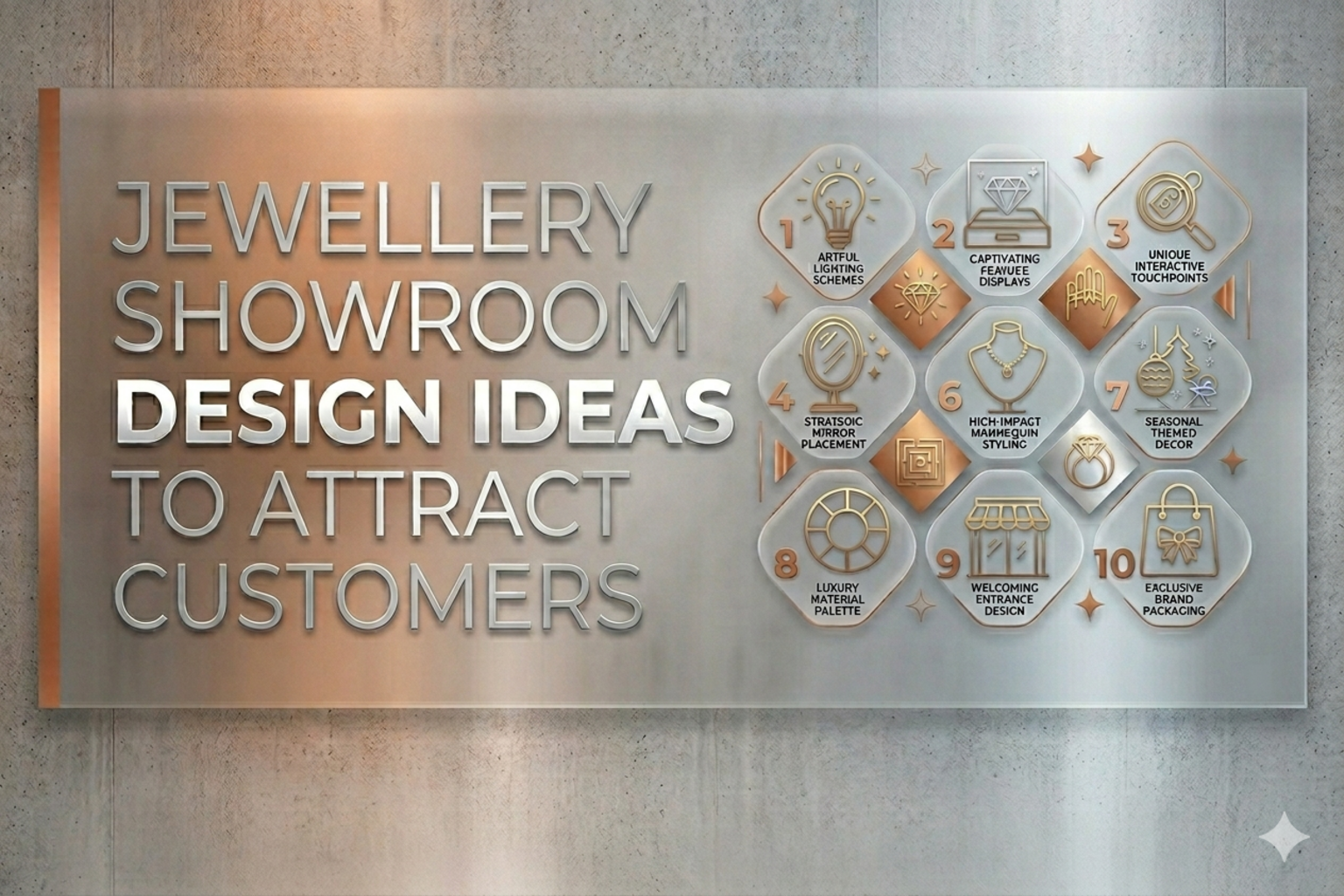
How jewellery showroom design influences luxury, customer experience, and attention
Imagine entering a jewellery store. No words are exchanged.
Yet the ambience communicates everything.
Soft lighting, a quiet atmosphere, and carefully placed pieces create a sense of calm and restraint.
Your surroundings are not distracting.
You feel present in the moment.
This is the distinction that matters.
This is where thoughtful jewellery showroom design becomes essential.
Jewellery showroom design is no longer solely about product display.
It is about creating an experience.
High-end customers value clarity, space, and the overall atmosphere more than quantity. Their decisions are influenced by how the store makes them feel.
A well-designed showroom avoids overwhelming first impressions.
It encourages customers to feel comfortable and at ease.
Layout is the first point of engagement.
Customers experience the space before noticing any products.
A clear layout enables effortless movement, eliminates confusion, and avoids unnecessary turns or visual clutter.
Large stores benefit from zoning, with distinct yet connected sections for bridal, everyday, and statement collections.
Smaller stores require precision, featuring fewer elements and intentional placement.
In both cases, the objective is consistent.
Create ease for the customer.
Lighting defines the sense of luxury.
In jewellery retail, lighting serves a purpose beyond functionality.
It creates an emotional response.
Balanced lighting reveals a diamond’s brilliance without glare, enhances the depth of gold, and uses shadows to add dimension rather than dullness.
Excessive lighting flattens the display, while insufficient lighting conceals details.
Optimal lighting achieves balance.
It goes for the big reveal.
Display zoning enhances clarity.
Displays should not compete for attention.
Ergo, zoning provides visual space and organisation.
A featured piece should have space, a collection should have context, and each counter should have a clear focus.
Structured displays guide the eye naturally and indicate where to pause effortlessly.
Minimalism is not emptiness.
In 2026, minimalism in jewellery showroom design is not about eliminating elements.
It is about refinement.
Fewer pieces. Better presentation. Clear surfaces. Strong focal points.
When displays are not excessive, each piece feels significant.
Effective minimalism does not diminish value.
It amplifies it.
Customer experience is now the key differentiator.
Today’s customers are not just purchasing jewellery.
They are seeking an experience.
Private viewing areas, inviting seating, and spaces that encourage customers to take their time are essential.
Experiential design is now expected, not optional.
High-end customers do not want to feel pressured to buy.
They want to feel understood and valued.
Branding should be felt, not seen.
A luxury brand does not need constant repetition.
It is evident in the materials, tone, and finishes.
Subtle branding creates stronger recall than prominent signage.
Consistent design reinforces brand identity without undue explanation.
Effective strategies for both small and large stores
Store size does not determine impact.
Clarity does.
A thoughtfully designed small store can feel more premium than a larger, cluttered space.
A well-structured large store can feel effortless rather than overwhelming.
Jewellery showroom design is not defined by scale.
It is about control and intention.
Key takeaways
A well-designed jewellery showroom does not demand attention.
It earns it through space, lighting, and structure.
When the layout is clear, the lighting is balanced, and the displays are intentional, the store begins to work quietly in the background.
This encourages customers to spend more time in the store.
At Vision Board Studio, we approach jewellery showroom design as a study of customer behaviour, perception, and brand identity.
Every element is thoughtfully considered, because in jewellery retail, what matters is not only what is displayed.
It is what prompts a customer to pause and engage.
If you are considering changes to your store, the solution may not be to add more elements.
Instead, focus on designing with greater clarity.
Let us start with that approach.