
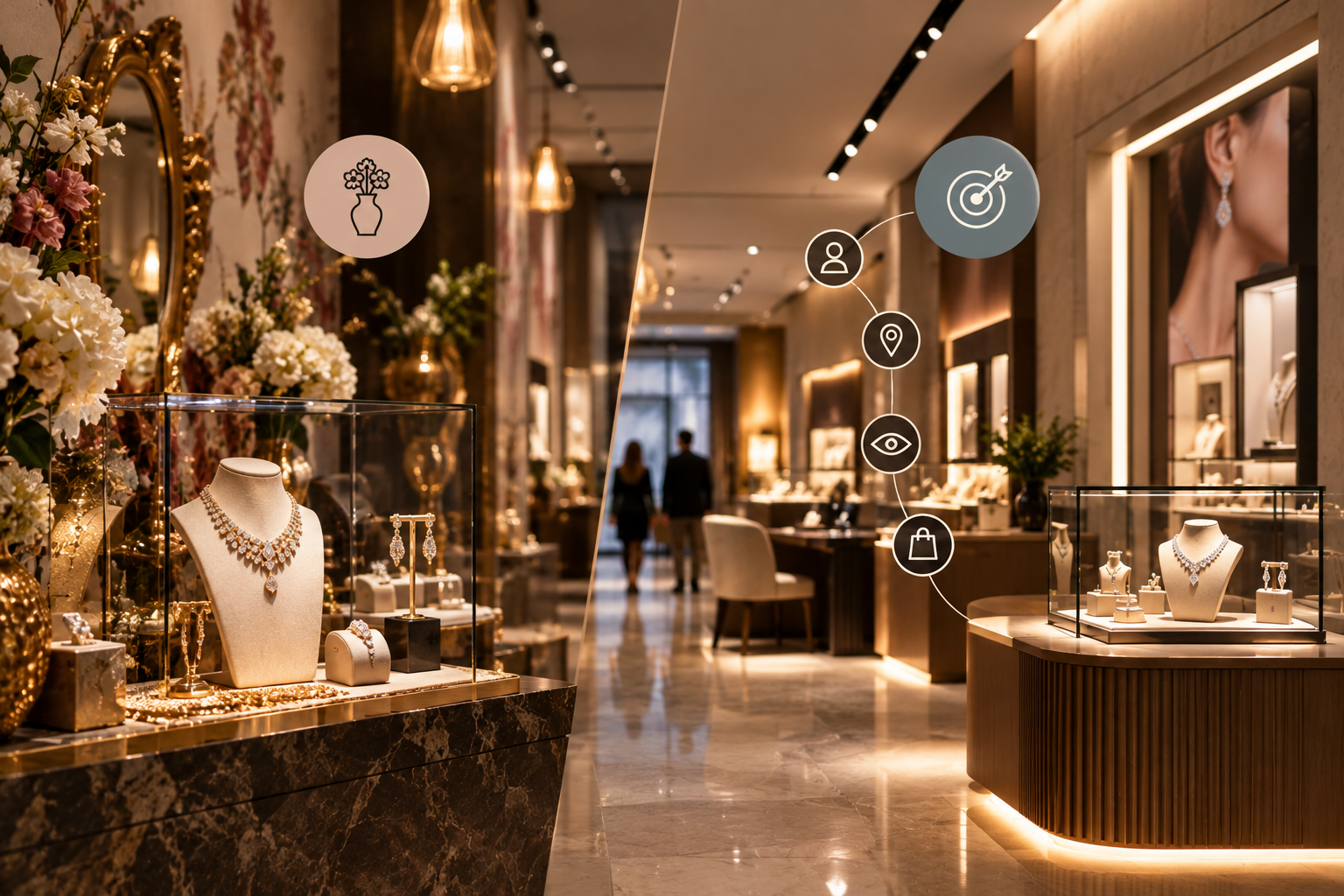
As a VM professional in jewellery, I see this quite often.
Retail design is brought in towards the end—once the store, products and brand identity are already decided.
Then comes the question:
“How should the store look?”
But in jewellery, the space is not just about looking beautiful.
It influences what the customer notices first, how they move through the store, what they stop to see and, most importantly, how they experience the jewellery.
Lighting, sightlines, display density, focal points and even the distance between showcases can change how a piece is perceived.
A beautiful store is not necessarily a well-designed store.
The real question is:
What is the space helping the customer see, feel and understand?
For me, that is where VM becomes strategic.
Design should not be the final layer added to a retail space.
It should be part of the thinking from the beginning.
Your Store Has 3 Seconds to Tell Its Story
I see the storefront as much more than the outer face of a store. It is the first conversation a brand has with its customer.
In a busy retail environment, a shopper is constantly surrounded by visual information — competing brands, signage, promotions, products and displays, all demanding attention. In those first few seconds, a jewellery store has to create enough interest for the customer to stop, look and want to discover more.
You cannot tell the entire story of a jewellery brand from the storefront. But you can set the expectation of what lies inside.
For me, effective jewellery VM starts with answering three questions almost immediately:
What does this brand stand for?
What kind of jewellery will I find here?
And why should I look closer?
This is where the storefront becomes an important part of the customer journey rather than simply an architectural element.
The window is your first edit
Jewellery is inherently visual, but that does not mean a window should showcase everything.
One of the most common mistakes I see is trying to communicate too many collections, messages and products within one display. The result is visual noise — and when everything is asking for attention, nothing gets it.
A strong jewellery window is carefully edited.
Product selection, scale, spacing, lighting, colour, props and composition all work together to establish a visual hierarchy. The customer should instinctively know where to look first, what to notice next and what story the display is communicating.
This is particularly important for jewellery because the product is often small, detailed and highly reflective. The VM challenge is not simply to make the jewellery visible, but to give each important piece the space and lighting it needs to create desire.
Differentiation goes beyond the logo
When several jewellery brands are selling similar categories or even similar products, putting a larger logo on the storefront is not necessarily the answer.
The differentiation can come through the way the brand is expressed visually — the choice of hero product, the mood of the window, the styling, the materials, the negative space, the lighting and the overall level of refinement.
These details communicate a brand’s personality before the customer has spoken to a salesperson or stepped inside.
And in jewellery retail, that first impression matters.
The storefront should not try to tell the whole brand story. It should create enough curiosity for the customer to want to continue the story inside.
Because in my experience, you don’t need three minutes to make an impact. You need three seconds to make someone stop